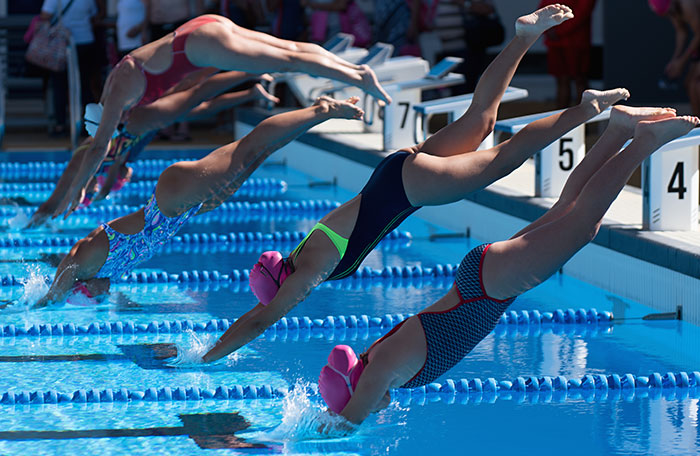
International swimming events are the most direct way to promote global swimming exchanges. The World Aquatics Championships, various competitions organized by FINA, and international invitational tournaments held by various countries have become important platforms for athletes from all over the world to show their strength and exchange skills.
-
Olympic Games
As the most influential sports event globally, the Olympic Games serve as the most important international exchange platform for swimming. Athletes, coaches, and referees share their respective training experiences through this international stage, gaining insights into swimming training methods and competitive strategies under different cultural backgrounds.
-
International Swimming Federation competitions
FINA (Fédération Internationale de Natation) is the supreme governing body for global swimming, organizing events such as the World Aquatics Championships, World Short Course Swimming Championships, and World Diving Championships. These competitions attract top swimmers from around the world, serving as vital platforms for cultural and technical exchange in the global swimming community.
Swimming demands high technical standards, particularly in terms of enhancing competitive levels, making the exchange of experiences between countries especially crucial. Many international sports organizations regularly hold swimming training camps, coach exchange programs, and specialized skill training sessions, providing athletes and coaches with opportunities for learning and further education.
-
International Swimming Coaches Conference
Every year, organizations such as FINA organize academic conferences and training courses for coaches, inviting world-class swimming coaches and athletes to share the latest training theories, methods, and experiences. Through these platforms, coaches can learn and draw upon the training philosophies and advanced technological methods of other countries.
-
Training Camps and Exchange Programs
Many countries and regions promote technical exchange and cooperation through the establishment of training camps and coach exchange programs. For example, Chinese swimming coaches have traveled to swimming powerhouses such as the United States and Australia to learn advanced training methods and philosophies.
International cooperation among athletes is mainly reflected in technical exchanges and transnational training. Many swimming powerhouses such as the United States and Australia accept swimmers and coaches from other countries, providing training resources and platforms to help them improve their competitive level. Meanwhile, some outstanding foreign swimmers will also go to other countries for training or exchange.
-
Cross-national Training Cooperation
For example, many top athletes choose to go to foreign training bases for high-level training or have intensive training in professional swimming teams abroad. In this process, athletes exchange techniques and experiences with colleagues from different countries, learn from each other and make progress together.
-
Athletes' Cross-Border Visits
After the World Swimming Championships or the Olympics, athletes usually engage in cross-border training and competition exchanges, especially during the off-season. Such cross-border exchanges help to enhance the competitive level of athletes and promote mutual understanding of different cultures.
With the continuous development of science and technology, the level of scientification in swimming techniques and training is getting higher and higher. Many countries and regions are constantly innovating training methods, equipment, and research in exercise physiology. International scientific research cooperation and technical exchanges are crucial for improving the global level of swimming.
-
Swimming Equipment and Technological Innovation
Many swimming powerhouses cooperate with technology companies to develop new swimsuits, electronic timing equipment, underwater motion monitoring systems and other technologies to improve the competitive performance of athletes. For example, the development of "Speedo LZR" swimsuit, which adopts new materials and design, helps to reduce water resistance and improve the performance of swimmers.
-
RESEARCH ON BIOMECHANICS AND SPORTS MEDICINE
Some international sports research institutions and universities cooperate to study the biomechanical principles and sports medicine in swimming technology, and promote the research on sports injury prevention and recovery of athletes.